Cast Net Technology

We write software
that holds up.

Cast Net Technology is a software engineering company based in the United States. We design, build, and operate custom systems — web applications, data pipelines, AI and retrieval infrastructure, developer tooling, and on-prem deployments — across whatever domain the work happens to live in. We take the craft seriously. We test what we ship. We stay engaged long after delivery.

What we build

Custom software, built with care.

We are an engineering company. That means we start with the code, not the pitch. Whatever the domain, whatever the stack, whatever the deployment target — we take the time to understand the problem, write the software properly, and stand behind it when it runs.

See our work →
Web applications and backends Python, TypeScript, Go. APIs, admin consoles, operator dashboards. Clean code, good tests, clear deployment stories.
Data systems and pipelines Ingestion, normalization, storage, retrieval. Streaming or batch. Postgres, SQLite, FTS, vector stores, or plain files — whichever the work actually needs.
AI and retrieval infrastructure LLM orchestration, RAG pipelines, context engines, MCP servers, local-model integration. We built and open-sourced Mnemosyne to scratch our own itch here.
Developer tooling and open source Libraries, CLIs, test harnesses, internal SDKs, build infrastructure. Some of it we release publicly; most of it lives inside the teams we built it with.
On-prem and private deployments When data can't leave your network, we are comfortable shipping software that runs in your environment — from a single container to a full appliance. No mandatory cloud, no default telemetry.
Integrations and connectors Building the plumbing between systems that weren't designed to talk to each other. Careful error handling, idempotent retries, observable failures. The unglamorous work that keeps the glamorous work running.
How we tend to be useful

A few shapes
the work usually takes.

Engagements come in from many directions and many industries. A few patterns come up often enough to be worth naming.

The thing no vendor sells

You have a specific workflow that off-the-shelf tools don't fit. You've tried adapting, and the adaptation has become its own problem. You need something built — properly — from the ground up, and then handed over to your team to operate.

The piece inside a larger system

You have a team building something ambitious, and one bounded part of the system needs to be right. A retrieval engine. A data pipeline. An integration. We come in, do that part carefully, document it properly, and step back out.

The private deployment

You like something the market offers but can't send the data to a cloud. We are comfortable building or adapting software to run inside your network — your hardware, your access controls, your audit trail — with no default egress and no mandatory telemetry.

How We Work

How an engagement
usually goes.

No two projects are the same, but most of ours travel through the same five stages. We move deliberately, we document as we go, and we keep decisions reversible.

01 — Conversation

Is this a fit?

We talk. You describe the problem, the constraints, the shape of success. We tell you honestly whether this is work we'd do well. Sometimes the answer is no, and that's a useful answer.

02 — Scope

Design before code

A written brief that names the architecture, the interfaces, the failure modes, and the evaluation criteria. You approve it before we start building. No surprises, no scope creep, no "we'll figure it out in implementation".

03 — Build

Write it properly

Version control, tests alongside code, documented interfaces, readable commits. You see it grow in real time — no hand-wave demos, no hidden black boxes.

04 — Harden

Make it real

Real data. Real load. Real edge cases. We find the rough edges before your users do. Evaluation packs, regression tests, and the boring observability work that makes a system trustworthy.

05 — Operate

Hand it over, stay available

Your team runs the software. We support it, fix bugs, ship updates. The code and the data stay yours. If you walk away, nothing breaks — that's the whole point.

How we think about the craft

A few quiet convictions.

These aren't slogans and we don't hand them out on a card. They're the arguments we keep having internally, the habits that survive across projects, and the reason clients keep inviting us back.

Reliability over cleverness

A clever solution that occasionally breaks is worse than a boring one that doesn't. We'd rather write three clear lines than one elegant one, and we think the readable commit history is a deliverable. The code that looks easy to maintain usually was not easy to write.

Tests are design, not paperwork

We write tests alongside the code, not after it, because the test is where the interface becomes real. A test suite is the most honest documentation a system can have — and when something breaks six months later, it's the thing you'll be grateful for.

Software should be legible

For the maintainers who come after us. For the auditors who will ask how a decision was made. For the clients who own the code once it ships. If we can't explain how a system works in a page or two, we haven't finished designing it.

Deliver and step back

We don't build systems that require us to stay forever. Our goal is that your team owns the code, understands it, and runs it confidently. We stay available for support and future work — but never as a dependency you couldn't live without.

A public example

Read the code, if you like.

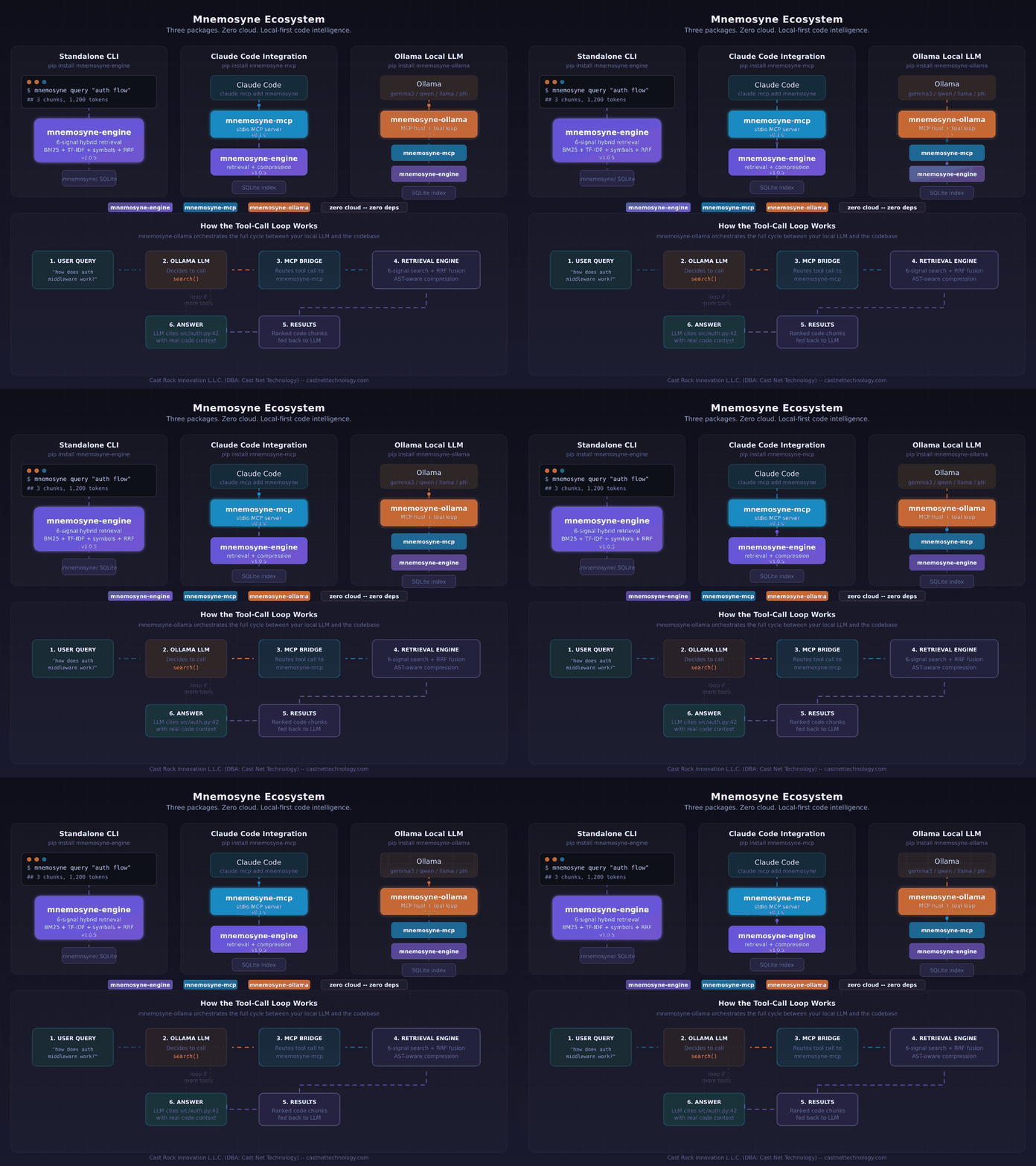
Most of what we build lives quietly inside the teams we built it with — not because we're secretive, just because that's the nature of custom work. One piece of our own internal engineering is out in the open though: Mnemosyne, our LLM context retrieval engine. It's probably the clearest window into how we actually write code — the test suite, the benchmarks, the release attestations, the commit history. No marketing around it. Read it on GitHub if you're curious.

  • mnemosyne-engine — retrieval engine, pure Python, zero runtime dependencies, 293 tests. Cuts typical LLM context waste by 74–78%.
  • mnemosyne-mcp — Model Context Protocol server for Claude Code, Cursor, Zed, and any MCP host.
  • mnemosyne-ollama — lightweight host for local LLMs via Ollama. One command, fully offline.
GitHub → Read the writeup → More of our work →
Animated diagram of the Mnemosyne ecosystem: the core retrieval engine feeds three delivery scenarios - standalone CLI, Claude Code via Model Context Protocol, and Ollama for local LLMs - with a shared tool-call loop connecting them
Mnemosyne, drawn as a system. (click to enlarge)

Have a project in mind?

Tell us what you are working on. We will read it carefully, ask the questions we actually have, and tell you honestly whether we are the right team for the job.

Get in touch →